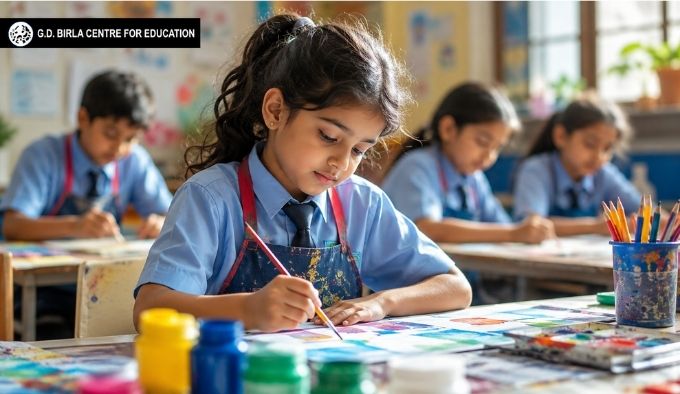
A child’s imagination often speaks before words can fully express it. A sketch, a rhythm, a colour choice or a dramatic performance can reveal curiosity, emotion and ideas that may remain hidden in conventional classroom settings. Art, therefore, is not simply an enjoyable break from academics; it can become a powerful way to learn, think, and understand the world.
This blog explores how creative activities influence young minds and why meaningful exposure to art can strengthen skills children need both inside and beyond the classroom.
The Creative Advantage: How Art Shapes Young Thinkers
At G.D. Birla Centre for Education, creativity forms an important part of a broader educational approach that values academic excellence alongside holistic development. As one of the reputable ICSE board schools in Kolkata, our vision emphasises creativity, diversity, and a passion for learning. At the same time, our academic framework encourages critical thinking, problem-solving, and communication. So, let’s explore how art transforms creativity into stronger thinking skills.
Art Encourages Independent Thinking
The first prominent advantage of art and creativity is that it encourages independent thinking. Art rarely has only one correct answer. When children create a drawing, design a composition or develop a performance, they make choices about colour, form, movement and expression. This freedom encourages them to explore possibilities instead of simply searching for predetermined answers.
Such experiences can gradually build independent thinking. Children learn that an idea can be approached from different directions; an important habit for academic learning as well as real-life decision-making.
Creativity Strengthens Problem-Solving Skills
Another very prominent benefit of creativity is its capacity to strengthen problem-solving skills. Every creative project involves small challenges. A student may need to decide how to represent an idea visually, organise a performance or transform an ordinary concept into something original. Solving these challenges requires observation, experimentation and adaptation.
G.D. Birla’s approach complements this creative process with experiential learning, critical thinking and problem-solving, particularly through our middle-school curriculum.
Art Gives Children a Stronger Voice
Not every child expresses ideas most comfortably through conventional academic work. In such a context, creative activities provide alternative forms of communication. For example, drama can develop expression, music can nurture sensitivity, while visual art can help students communicate thoughts and emotions without relying entirely on words.
The school offers opportunities across dramatics, music, dance, calligraphy and other creative pursuits. Our clubs also include dedicated spaces for art, drama, music, dance and fashion design.
Creative Learning Builds Confidence
Completing a creative project gives children something tangible to share. Therefore, presenting artwork, performing on stage or participating in an inter-house activity can help students become more comfortable with visibility and constructive feedback.
Over time, these experiences can strengthen self-confidence and facilitate students to participate more actively in classroom discussions, competitions and collaborative projects.
Art Connects Imagination with Real-World Learning
Do you know that creative thinking does not belong only to artists? Scientists, architects, designers, entrepreneurs and technology professionals also need imagination to develop new ideas and solve unfamiliar problems.
G.D. Birla Centre for Education reflects this broader understanding of learning through activities ranging from art and music to coding, film studies, content writing, interior designing, and public speaking. This variety allows students to discover different interests while developing a flexible mindset.
A School Environment Can Make Creativity Flourish
Creativity grows best when children have opportunities to experiment, collaborate and discover their individual strengths. G.D. Birla Centre for Education combines modern facilities and experienced faculty with a student-centric approach that recognises individual abilities and promotes holistic development.
Our field-based learning opportunities, clubs and co-curricular programmes further extend education beyond textbooks, creating more avenues for curiosity and exploration.
The Final Words
In summary, art is not only about adding colours to childhood. It teaches children to observe closely, think differently, communicate confidently and approach challenges with imagination. When schools make creativity a meaningful part of education, students can gain skills that remain valuable long after a particular painting is finished, or a performance ends.
At G.D. Birla Centre for Education, the emphasis on creative pursuits alongside academics reflects a wider commitment to developing confident, thoughtful and future-ready learners. By giving young minds room to imagine, create and experiment, the school helps transform creativity into a lasting advantage. So don’t wait any longer and search for the term ‘private middle schools near me’. Get in touch with us for more detailed information.