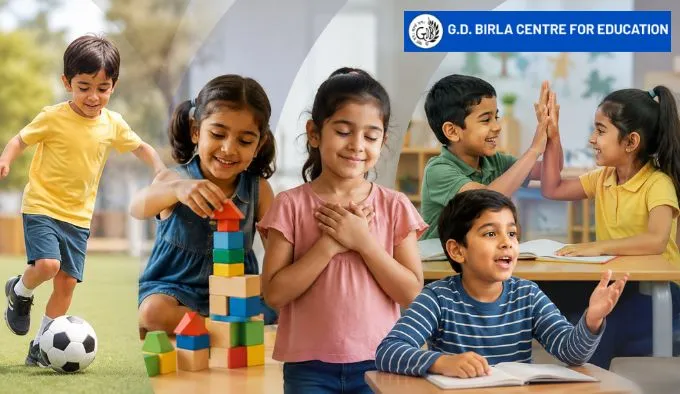
A child’s development is never a single-track journey. A curious question, a new friendship, a confident step on a playground, or the ability to express a feeling can all mark meaningful progress. Behind these everyday moments lies a complicated process shaped by learning, relationships, health, environment, and opportunities to explore. According to UNICEF India, over 43% of children under five are at risk of not fulfilling their full developmental potential, highlighting why nurturing care and enriching early experiences matter.
This blog highlights the five essential pillars of child development and explores how a thoughtfully designed school environment can nurture them together. As a reputable nursery schools in Kolkata, G.D. Birla Centre for Education focuses on holistic development as an important part of its educational approach. Alongside academic, physical, emotional, and social growth and values, we also prioritise co-curricular enrichment.
The Five Essential Pillars of Child Development
Here are five foundational dimensions that collectively shape a child’s holistic growth and lifelong development.
Physical Development: Building a Healthy Foundation
The first notable pillar of child development is physical development. Physical development includes growth, coordination, balance, strength, and fine motor skills. Children develop these abilities through movement, play, sports, and hands-on activities. Physical well-being also supports concentration and readiness to learn.
G.D. Birla Centre for Education incorporates indoor and outdoor play, physical training, and sports into its educational framework. Our pre-primary programme also uses activities that strengthen fine motor skills, while art, craft, music, and movement give children varied ways to coordinate and express themselves.
Cognitive Development: Encouraging Young Minds to Think
Another vital dimension of holistic child development is cognitive growth, which strengthens a child’s ability to think, reason, learn, remember, and solve problems. Cognitive development involves memory, attention, reasoning, creativity, problem-solving, and decision-making. Remember, children can learn most effectively when they are encouraged to investigate instead of simply memorising information.
This principle is visible in G.D. Birla’s activity-oriented approach. Our pre-primary curriculum includes puzzles, logical thinking, problem-solving, and inquiry-based learning, while the primary curriculum encourages children to learn through activities and experiences. Such methods can make academic concepts more meaningful and stimulate intellectual curiosity.
Emotional Development: Understanding Feelings and Building Confidence
Emotional development enables children to recognise feelings, manage emotions, develop resilience and gradually become more confident in unfamiliar situations. A supportive environment can help children feel secure enough to ask questions, make mistakes and try again.
G.D. Birla Centre for Education follows a child-centred philosophy that values every student and their individual strengths. The school also highlights behavioural development as a key part of its educational approach, alongside academics and cultural values.
Social Development: Learning to Connect and Collaborate
Social development plays a crucial role in shaping how children form relationships, cooperate with others, communicate effectively, and gradually understand their role within a community. We all know that children never grow in isolation. They learn essential social skills by communicating, cooperating, sharing responsibilities, and respecting different perspectives. Group activities, sports, cultural programmes and classroom interactions provide natural opportunities to develop these abilities.
At G.D. Birla, the emphasis on community, collaboration and co-curricular participation complements classroom learning. Activities involving music, dance, art, sports and clubs allow students to discover interests while learning how to participate constructively with others.
Language and Communication Development: Giving Ideas a Voice
Communication is central to learning and relationships. Strong language skills help children understand instructions, express ideas, ask questions, participate in discussions and communicate confidently.
G.D. Birla places considerable emphasis on English language development within its English-medium ICSE framework. Our primary curriculum combines language learning with activities, creative subjects, and value-based education, creating opportunities for children to communicate across different settings.
Why All Five Pillars Matter Together
All five pillars of child development are closely connected. A child who feels emotionally secure may participate more confidently; physical activity can support coordination; communication can strengthen relationships; and social experiences can encourage problem-solving. Therefore, effective education should not treat development as separate compartments.
This is where the philosophy of G.D. Birla Centre for Education becomes particularly relevant. Established in 1973 under the Ashok Hall Group of Schools, the institution combines academic learning with sports, arts, music, values, mentoring, and co-curricular experiences. Our approach focuses on preparing students not only for examinations but also for responsible and confident participation in life.
The Closing Thoughts
True child development extends far beyond academic achievement. It is about nurturing a healthy body, an inquisitive mind, emotional confidence, meaningful relationships, and the ability to communicate with clarity. When these five pillars grow together, children can gain a stronger foundation for lifelong learning.
For parents seeking an educational environment that values holistic development alongside academic excellence, G.D. Birla Centre for Education offers a thoughtful blend of child-centred learning, experienced educators, modern facilities, and diverse co-curricular opportunities. So why wait? Connect with a good ICSE schools in Kolkata now, like G.D. Birla Centre for Education, and nurture your child’s academic potential, confidence, creativity, and holistic development.